Explore how India’s local Kirana stores evolved into powerful e-commerce players. Discover digital transformation, hybrid retail models, and the future of India’s small business revolution.
Introduction
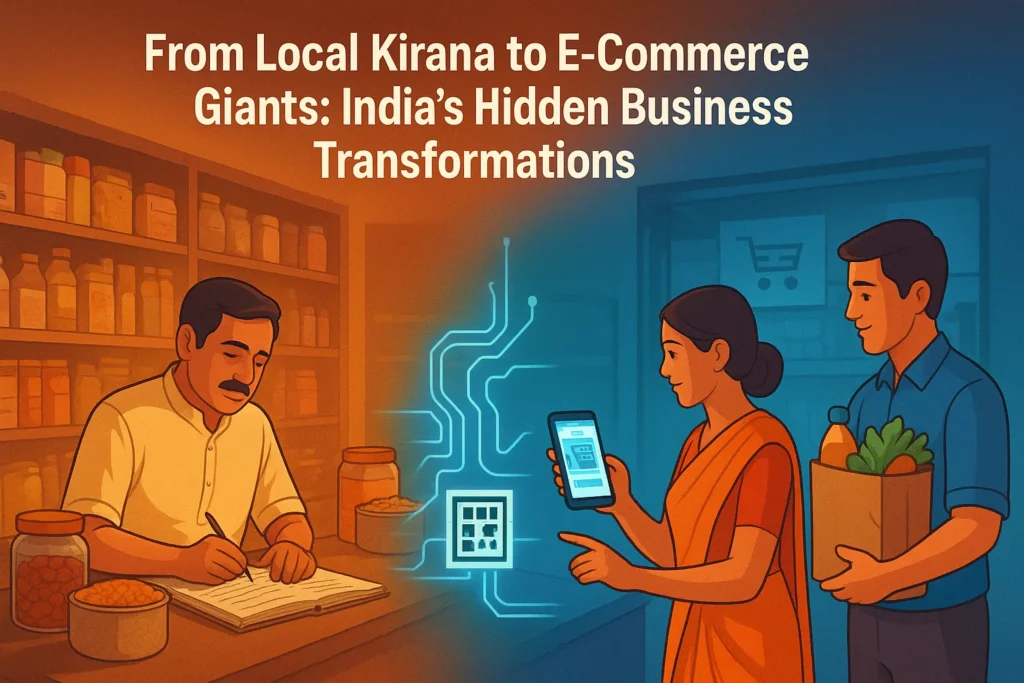
For decades, India’s local Kirana stores have been the heartbeat of neighborhood shopping — personal, convenient, and trusted. From selling daily essentials to offering credit to loyal customers, these small stores have been the unsung heroes of India’s retail economy.
But in the past decade, a silent revolution has taken place. Powered by digitization, smartphone adoption, and government initiatives like Digital India, these traditional Kiranas are transforming into digital-first businesses, competing alongside e-commerce giants like Amazon, Flipkart, and Reliance JioMart.
This transformation represents more than a retail shift — it’s the story of India’s evolving economy, where local meets global, and tradition meets technology.
The Evolution: From Kirana Counters to Click-and-Collect
1. The Traditional Kirana Model
India’s Kirana stores are small, family-run retail shops, usually located within walking distance of residential areas.
They thrive on:
- Personal relationships with customers
- Flexible credit systems
- Quick home delivery
- Localized product selection
For years, these stores operated with minimal technology — relying on handwritten ledgers and word-of-mouth marketing.
2. The Digital Shift
The COVID-19 pandemic acted as a catalyst, forcing even the most traditional shopkeepers to explore digital payment systems, online ordering, and WhatsApp-based deliveries.
Suddenly, the humble Kirana store became digitally enabled, using:
- UPI and QR codes for payments
- Inventory management apps
- Partnerships with online platforms like JioMart, Amazon Easy, and Paytm Mall
The Forces Driving This Transformation
1. Digital India & Fintech Boom
Government-led initiatives like Digital India and UPI have brought affordable internet and seamless digital payment systems to every corner of the country.
Stat:
Over 300 million Indians now use UPI for everyday transactions, allowing even micro-retailers to accept cashless payments.
2. Affordable Smartphones & Data
India’s internet revolution, led by Jio’s low-cost data plans, made it possible for small business owners to access e-commerce apps, payment tools, and social media marketing.
3. E-Commerce Partnerships
Platforms like Amazon Easy, Flipkart Wholesale, and JioMart Partner empower Kirana owners to:
- Access bulk inventory
- List products online
- Offer pickup points for customers
4. Consumer Behavior Shift
Urban and semi-urban consumers now prefer the convenience of online shopping while still valuing trust and proximity offered by Kiranas. This has given rise to a hybrid retail model — blending online convenience with offline reliability.
Hybrid Commerce: The Future of Indian Retail
What is Hybrid Commerce?
Hybrid commerce (also known as phygital retail) combines physical stores and digital platforms.
Customers can:
- Order online
- Pick up in-store
- Pay digitally
- Receive personalized recommendations
This model gives local Kiranas a powerful edge — allowing them to retain traditional customers while attracting tech-savvy shoppers.
Example:
A neighborhood grocery store in Pune uses WhatsApp for order collection, UPI for payments, and Zomato Instamart for same-day delivery — effectively competing with full-scale online retailers.
E-Commerce Giants Empowering Small Retailers
1. Amazon Easy
Amazon’s Easy program converts local Kiranas into digital stores. Shopkeepers help customers browse and order products online and earn commissions — making them an extension of Amazon’s vast network.
2. JioMart Partner Program
Reliance’s JioMart Partner Central integrates local stores into its ecosystem, providing:
- Digital catalogs
- Inventory management tools
- Delivery support
3. Flipkart Wholesale
Flipkart’s B2B arm allows Kiranas to buy directly from manufacturers, improving profit margins and reducing middlemen dependency.
Benefits of Digital Transformation for Kiranas
1. Increased Sales and Reach
Online visibility enables small retailers to reach customers beyond their immediate neighborhood.
2. Improved Efficiency
Digital billing, inventory apps, and analytics tools streamline operations and reduce manual errors.
3. Better Customer Retention
CRM (Customer Relationship Management) apps and digital loyalty programs help shopkeepers track customer preferences and offer personalized deals.
4. Financial Inclusion
Access to digital payments and microloans helps small businesses expand faster.
5. Competitive Edge
With tools like Google My Business and WhatsApp Business, Kiranas now market themselves like mini-brands.
Real-Life Success Stories
1. Gupta Kirana, Delhi
During the pandemic, Gupta Kirana launched a WhatsApp-based ordering system. Within months, sales increased by 30%, and regular customers started paying digitally.
2. Smart Bazaar, Bengaluru
Partnering with Amazon Easy, this local store expanded into electronics and fashion items, turning into a community e-commerce hub.
3. Rural Maharashtra Co-op Store
Through JioMart, small rural stores gained access to thousands of SKUs (stock keeping units) and digital payments, empowering farmers and local vendors.
Challenges of Digital Transformation
Despite the success, the journey isn’t without hurdles:
- Digital literacy gaps among older shop owners
- High platform commissions
- Dependence on tech support and internet stability
- Competition with large retailers
Yet, government and private initiatives are actively addressing these gaps through digital training programs and microfinancing schemes.
The Future: A Digital Bharat
India’s retail sector is expected to reach $2 trillion by 2032, with 70% driven by digital-first models.
The coming years will see:
- AI-driven inventory management
- Voice-based shopping for local languages
- Seamless cross-platform commerce
- Hyperlocal delivery networks powered by drones
In essence, India’s retail revolution is not about Kirana vs. E-commerce — it’s about Kirana + E-commerce.
Together, they’re building a resilient, inclusive digital economy.
Conclusion
The story of India’s Kirana transformation is a testament to adaptability and innovation.
What started as small neighborhood shops is now becoming the backbone of India’s e-commerce revolution.
By embracing technology while preserving their local touch, these stores are not just surviving — they’re thriving in the digital era.
The fusion of local trust with digital convenience is shaping a new India — one that’s globally competitive yet deeply rooted in community values.
FAQ’s
1. What is the Kirana-to-e-commerce transformation?
It refers to the digital evolution of India’s small neighborhood shops (Kirana stores) adopting online platforms, digital payments, and hybrid business models.
2. How did COVID-19 impact Indian Kiranas?
The pandemic accelerated digitization, pushing many stores to use online ordering, delivery apps, and digital payment systems.
3. What is a hybrid retail model?
Hybrid retail combines physical stores with digital platforms, allowing customers to shop online and offline seamlessly.
4. How are e-commerce platforms helping Kirana stores?
Platforms like Amazon Easy, JioMart Partner, and Flipkart Wholesale help small stores expand product range, manage inventory, and earn commissions.
5. What are the benefits of digitizing Kirana stores?
Benefits include higher sales, better efficiency, customer loyalty, financial inclusion, and data-driven decision-making.
6. What challenges do Kirana owners face during digital adoption?
Challenges include lack of technical knowledge, internet access issues, and high competition from large retailers.
7. What is the future of India’s Kirana sector?
The future lies in “phygital retail”, where physical stores integrate with online systems for seamless customer experiences.
Disclaimer
This article is for educational and informational purposes only. The content reflects general trends and examples related to India’s retail transformation and should not be considered financial or business advice.
Internal Link :-
- Best Home Workouts Without Equipment: Build Strength Anytime, Anywhere
- 7-Day Healthy Meal Plan for Beginners: Simple & Delicious Recipes
- Sugs Lloyd IPO 2025 – Dates, Price Band, GMP, Allotment & Review
- Snehaa Organics IPO 2025 – Price Band, GMP, Subscription, Allotment & Detailed Review
- Goel Construction Company Ltd IPO: GMP, Price Band, Allotment, and Listing Details

I don’t think the title of your article matches the content lol. Just kidding, mainly because I had some doubts after reading the article. https://accounts.binance.com/es-AR/register?ref=UT2YTZSU
Your article helped me a lot, is there any more related content? Thanks!
I don’t think the title of your article matches the content lol. Just kidding, mainly because I had some doubts after reading the article.