Explore how India’s ambitious green hydrogen mission aims to revolutionize its energy sector, reduce carbon dependence, and position the nation as a global clean energy leader.
Introduction
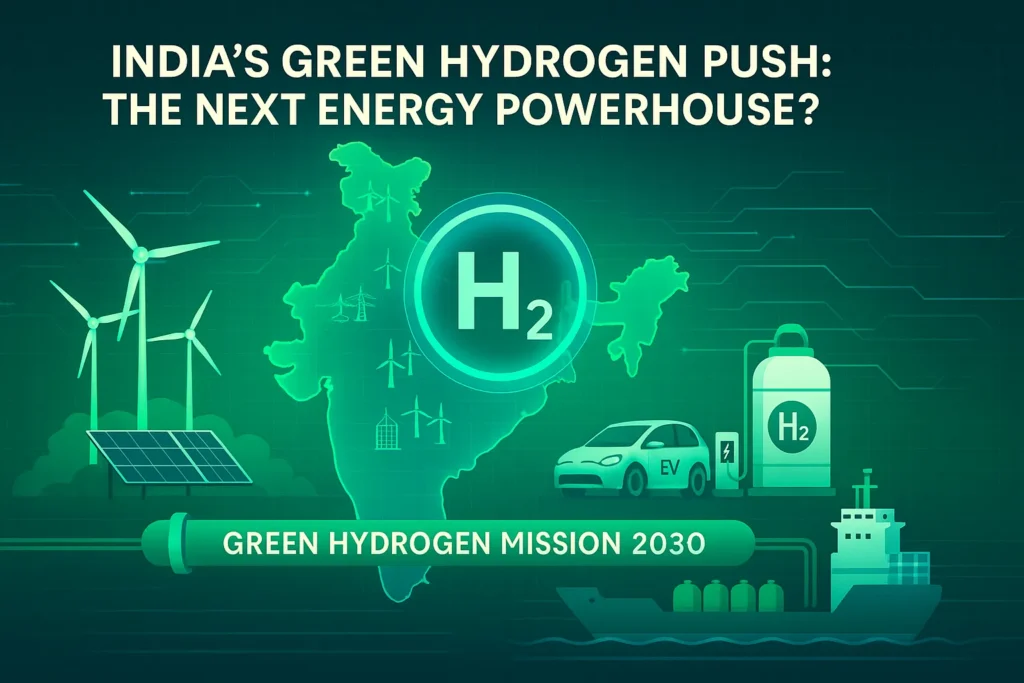
The world is on the brink of a clean energy revolution, and India is placing a bold bet on green hydrogen—a fuel that could redefine the country’s energy landscape. With its ambitious National Green Hydrogen Mission, India aims to become a global hub for the production, consumption, and export of clean hydrogen by 2030.
But can this ambitious vision truly transform India into the next energy powerhouse, or is it an overhyped dream in a fossil-fuel-driven world? Let’s explore.
What Is Green Hydrogen?
Green hydrogen is produced by splitting water (H₂O) into hydrogen and oxygen using renewable energy like wind or solar power. Unlike grey or blue hydrogen (which rely on natural gas and emit carbon dioxide), green hydrogen emits zero greenhouse gases, making it a clean and sustainable fuel of the future.
Types of Hydrogen at a Glance:
| Type | Source | Carbon Emissions |
|---|---|---|
| Grey Hydrogen | Produced from natural gas | High |
| Blue Hydrogen | Natural gas with carbon capture | Medium |
| Green Hydrogen | Produced using renewable electricity | Zero |
India’s National Green Hydrogen Mission
Launched by the Government of India
In January 2023, the Indian government approved the National Green Hydrogen Mission (NGHM) with an outlay of ₹19,744 crore (≈$2.3 billion). The goal is to make India energy independent by 2047 and net zero by 2070.
Mission Targets:
- Produce 5 million metric tonnes (MMT) of green hydrogen annually by 2030.
- Create 125 GW of renewable energy capacity dedicated to hydrogen production.
- Attract ₹8 trillion (≈$100 billion) in total investments.
- Generate 600,000+ green jobs across industries.
Why Green Hydrogen Matters for India
1. Energy Security
India imports over 85% of its crude oil and 50% of its natural gas, making it vulnerable to global price shocks. Green hydrogen offers energy independence through domestic renewable resources.
2. Climate Goals & Net Zero Vision
To meet the Paris Agreement and its 2070 net-zero pledge, India needs to decarbonize hard-to-abate sectors—like steel, cement, and transportation. Green hydrogen provides a feasible path.
3. Industrial Transformation
Industries like fertilizers, oil refining, and steel manufacturing rely on grey hydrogen. Replacing it with green hydrogen could slash millions of tonnes of CO₂ emissions annually.
4. Export Opportunities
Countries like Japan, South Korea, and the EU are seeking green hydrogen imports. India’s low-cost renewable energy and vast solar potential give it a major competitive edge in global markets.
Sectors That Will Benefit from Green Hydrogen
1. Transportation
Green hydrogen can power fuel-cell electric vehicles (FCEVs), especially in heavy transport—buses, trucks, trains, and shipping.
- Example: Indian Railways is testing hydrogen-fueled trains to reduce diesel dependency.
2. Industrial Manufacturing
Hydrogen-based steelmaking could reduce India’s carbon emissions by 30–40%.
- Example: Tata Steel and JSW are exploring pilot projects using hydrogen furnaces.
3. Power Generation
Hydrogen can be used to store excess renewable energy, ensuring 24/7 clean power supply even when the sun isn’t shining or wind isn’t blowing.
4. Fertilizer Production
Green ammonia—derived from green hydrogen—can replace fossil-fuel-based feedstock in fertilizer plants, helping India achieve agricultural sustainability.
Global Competition: Where Does India Stand?
| Country | Target Year | Annual Hydrogen Goal | Investment (USD) |
|---|---|---|---|
| India | 2030 | 5 MMT | $100 billion |
| EU | 2030 | 10 MMT | $430 billion |
| USA | 2030 | 10 MMT | $400 billion (Inflation Reduction Act) |
| Australia | 2030 | 3 MMT | $200 billion |
India may lag in infrastructure but has cost advantages in renewable energy—one of the lowest solar tariffs in the world—and abundant land for large-scale hydrogen hubs.
Key Green Hydrogen Projects in India
1. Reliance Industries (RIL)
Mukesh Ambani announced plans to produce green hydrogen at $1 per kg by 2030 and build Giga Factories for electrolysers and solar modules in Jamnagar, Gujarat.
2. Adani Group
Adani New Industries aims to produce 1 MMT per year of green hydrogen by 2030 in partnership with TotalEnergies.
3. NTPC & Indian Oil
Public sector giants are developing pilot hydrogen refueling stations and green ammonia plants in Rajasthan and Gujarat.
4. Greenko & ReNew Power
Private energy companies are setting up integrated hydrogen valleys, blending renewables, electrolysis, and industrial use cases.
Challenges to Overcome
1. High Production Costs
Green hydrogen currently costs $4–6 per kg, while grey hydrogen is around $1.5–2 per kg. The gap needs to narrow for large-scale adoption.
2. Lack of Infrastructure
India needs massive investments in hydrogen pipelines, storage, and transport networks.
3. Electrolyser Manufacturing
India currently imports most electrolysers from Europe and China. Scaling domestic production is essential.
4. Water Usage Concerns
Producing hydrogen requires large quantities of purified water—a potential issue in India’s water-scarce regions.
5. Policy & Standardization
Clear regulations on hydrogen certification, pricing, and safety standards are still evolving.
India’s Competitive Edge
- World’s lowest renewable energy costs (as low as ₹2 per kWh).
- Strong policy support under the National Hydrogen Mission.
- Strategic geographic location for export to Europe, Japan, and the Middle East.
- Growing innovation ecosystem with startups focusing on green technologies.
The Road Ahead: Can India Become a Green Hydrogen Superpower?
If India maintains its policy momentum, attracts private investments, and strengthens R&D in electrolysis and storage, it can emerge as a top 3 global player in green hydrogen by 2030.
The next decade will be decisive. With the right mix of technology, capital, and commitment, India could turn its green hydrogen vision into a reality—transforming not only its energy sector but the global energy map.
Conclusion
India’s green hydrogen journey represents more than an energy transition—it’s an economic revolution in the making. As the world shifts from fossil fuels to renewables, India’s leadership in this clean fuel frontier could redefine its global position.
While challenges remain, the roadmap is clear: with innovation, investment, and infrastructure, India can indeed become the next energy powerhouse—one fueled by the green molecule of the future.
FAQ’s
1. What is green hydrogen?
Green hydrogen is produced by splitting water using renewable electricity, resulting in zero carbon emissions and making it a clean energy source.
2. Why is green hydrogen important for India?
It helps India reduce carbon emissions, achieve energy independence, create jobs, and become a global clean energy exporter.
3. What is the National Green Hydrogen Mission?
Launched in 2023, it aims to make India a global hub for green hydrogen production with a target of 5 MMT per year by 2030.
4. Which companies are leading India’s green hydrogen push?
Major players include Reliance Industries, Adani Group, NTPC, Indian Oil, and ReNew Power.
5. What challenges does India face in green hydrogen adoption?
High production costs, lack of infrastructure, limited electrolyser manufacturing, and water usage constraints are key hurdles.
6. Can India export green hydrogen?
Yes. India’s low-cost renewables make it a strong potential exporter to energy-hungry regions like Europe, Japan, and South Korea.
7. What is the future of green hydrogen in India?
With government support and technological innovation, India is poised to become one of the top three global producers by 2030.
Disclaimer
This article is for educational and informational purposes only. It does not constitute investment, financial, or energy policy advice. Readers are encouraged to verify facts and consult experts before making any business or policy decisions.

Can you be more specific about the content of your article? After reading it, I still have some doubts. Hope you can help me.