Explore how 5G, artificial intelligence, and the new space race are shaping global geopolitics. Learn how nations compete for power, security, and technological dominance.
Introduction
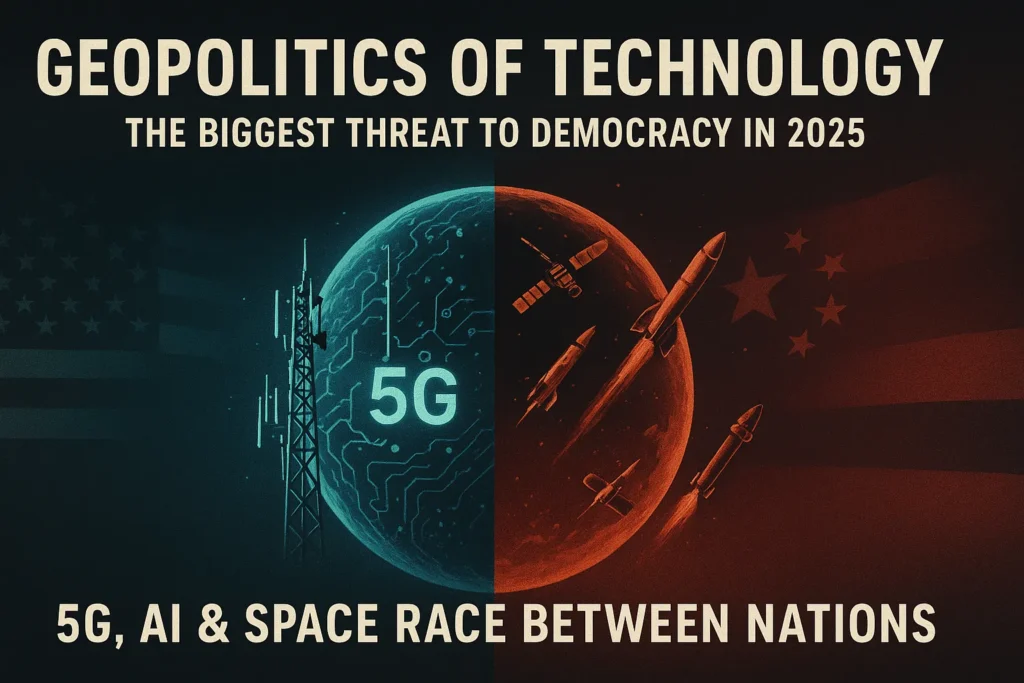
In the 21st century, wars are no longer fought only with weapons—they are fought with technology. From 5G networks and artificial intelligence (AI) to the renewed space race, global powers are battling for dominance in innovation, data, and connectivity.
Technology is not just a tool—it has become a weapon of influence, economic growth, and national security. The nations leading these sectors are reshaping global geopolitics, while those left behind risk becoming dependent on technological superpowers.
This blog explores how 5G, AI, and the space race are rewriting the rules of geopolitics, highlighting the opportunities, risks, and the future of global power balance.
The Rise of Tech Geopolitics
From Military Power to Tech Power
Historically, nations competed for military strength and natural resources. Today, control over digital infrastructure and emerging technologies is equally—if not more—important.
- Data is the new oil. Whoever controls data, controls influence.
- Technology drives economies. Countries with advanced AI, 5G, and space capabilities gain economic and political leverage.
- Cybersecurity = National security. A single cyberattack can cripple entire nations.
5G : The Battle for Global Connectivity
Why 5G Matters
5G is not just about faster internet—it powers smart cities, autonomous vehicles, telemedicine, and military communication systems. Control over 5G infrastructure equals control over future economies.
Global Competition
- China’s Huawei leads the 5G revolution, sparking security concerns in the U.S. and Europe.
- The U.S. and allies have pushed back, banning or restricting Huawei in critical networks.
- India, Japan, and South Korea are building independent 5G ecosystems to avoid overreliance on a single power.
Geopolitical Implications
- Nations controlling 5G will influence data flows, surveillance, and digital sovereignty.
- Countries lagging in 5G risk being left behind in innovation, defense, and global competitiveness.
Artificial Intelligence: The Digital Arms Race
AI as a Geopolitical Weapon
AI is at the core of autonomous weapons, surveillance systems, economic forecasting, and healthcare breakthroughs. Nations leading AI are not only advancing economically but also gaining strategic dominance.
The U.S. vs China Rivalry
- China has set a goal to become the global AI leader by 2030, with heavy investments in surveillance and smart cities.
- The U.S. remains strong in private-sector AI innovation (Google, OpenAI, Microsoft), but faces competition from China’s state-driven approach.
Other Players
- European Union (EU): Focused on ethical AI and privacy regulations.
- India: Emerging as an AI hub with growing startups and government-backed initiatives.
- Middle East: Investing in AI for smart cities like Saudi Arabia’s NEOM project.
Benefits & Risks of AI in Geopolitics
- Pros: Enhanced national security, economic growth, healthcare innovations.
- Cons: Risk of mass surveillance, job losses, autonomous weapons, and cyber warfare.
The New Space Race: Beyond Earth
Why Space Matters Again
Space is no longer just about exploration—it’s about military security, communication satellites, asteroid mining, and global internet access.
Key Players in the Space Race
- United States (NASA + SpaceX): Leading commercial space exploration and Mars missions.
- China: Rapidly advancing with moon missions, space stations, and military satellites.
- Russia: Traditional player, though struggling to maintain dominance.
- India: Gaining recognition with Chandrayaan-3 moon landing and cost-effective missions.
- Private Sector: SpaceX, Blue Origin, and others are changing the economics of space travel.
Geopolitical Implications
- Satellites power communication, defense, and navigation systems.
- Space dominance = strategic advantage in war and global influence.
- Future conflicts may extend into space weaponization.
Technology as a New Global Power Tool
1. Economic Dominance
Tech-driven nations lead in trade, manufacturing, and innovation.
2. Cybersecurity and Warfare
Cyberattacks are replacing traditional warfare, making cyber defense a top priority.
3. Influence on Developing Nations
Countries like China are exporting 5G and AI infrastructure to Africa, Asia, and Latin America, creating long-term geopolitical influence.
4. Ethical and Legal Challenges
Who owns space? Who controls global AI rules? International laws are lagging behind technological progress.
Conclusion
The geopolitics of technology is the new battlefield of the 21st century. Nations that dominate 5G, AI, and space exploration will not only control innovation but also shape global politics, economies, and security frameworks.
As the competition heats up, the world faces two possible futures: a fragmented tech Cold War with divided spheres of influence, or a collaborative future where nations work together for global progress.
The choices made today will define the balance of power for decades to come.
Disclaimer
This blog is for educational purposes only. It does not promote or endorse any political party, nation, or ideology.
FAQ’s
1. Why is 5G important in geopolitics?
Because 5G controls global connectivity, smart cities, and critical infrastructure, making it a tool of national power.
2. How is AI shaping international relations?
AI gives nations economic growth, military advantage, and surveillance power, making it a key driver of global competition.
3. Which countries are leading in the new space race?
The U.S., China, Russia, India, and private companies like SpaceX are dominating space exploration and satellite deployment.
4. Is technology replacing traditional warfare?
Not entirely, but cyberattacks, AI weapons, and space satellites are becoming central in modern conflicts.
5. How does technology impact developing countries?
Developing nations often adopt infrastructure from tech superpowers, creating dependencies and geopolitical influence.
6. Can global cooperation in technology happen?
Yes, but it requires international agreements on AI ethics, space laws, and cybersecurity protocols.
7. What is the biggest risk of tech geopolitics?
A potential “tech Cold War” where nations split into rival digital ecosystems, limiting collaboration and increasing tensions.
Internal Link :-
- Best Home Workouts Without Equipment: Build Strength Anytime, Anywhere
- 7-Day Healthy Meal Plan for Beginners: Simple & Delicious Recipes
- 10 Best Apps to Save Money in 2025: Smart Budgeting & Financial Freedom
- How to Start Investing with Just $100 in 2025
- Best Side Hustles for Beginners to Make $500/Month in 2025

Reading your article helped me a lot and I agree with you. But I still have some doubts, can you clarify for me? I’ll keep an eye out for your answers.
Your article helped me a lot, is there any more related content? Thanks!