Success in your career often depends on choosing the right path — and today, many professionals are debating between freelancing and entrepreneurship.

Introduction
In today’s digital age, many people are moving away from traditional 9-to-5 jobs and exploring new career paths. Two of the most popular options are Freelancing and entrepreneurship. Both offer independence, flexibility, and the chance to design your own career. However, while Freelancing focuses on offering personal skills and services, entrepreneurship involves building a business that can grow beyond you.
If you’re torn between freelancing and entrepreneurship, this guide will help you understand the differences, pros, cons, and which path aligns best with your goals.
What is Freelancing?
Freelancing means offering your skills and services to clients on a project-by-project basis. You’re essentially self-employed, and you work independently without committing to one employer.
Examples of Freelancing Jobs
- Graphic design
- Web development
- Content writing
- Social media management
- Digital marketing
- Video editing
Benefits of Freelancing
- Flexibility: Work from anywhere, anytime.
- Low entry barrier: Start with just a laptop and internet connection.
- Variety of work: Opportunity to work with multiple clients and industries.
- Direct income: You get paid for your time and skills.
Challenges of Freelancing
- Unstable income: Work depends on finding clients.
- Time for money trade-off: Earnings stop if you stop working.
- No employee benefits: No paid leave, health insurance, or retirement plans.
What is Entrepreneurship?
Entrepreneurship involves starting and running a business to create long-term value. Unlike freelancing, entrepreneurship isn’t just about personal skills — it’s about building systems, products, and teams that can scale.
Examples of Entrepreneurs
- Jeff Bezos (Amazon)
- Elon Musk (Tesla, SpaceX)
- Sara Blakely (Spanx)
- Small business owners running e-commerce stores, SaaS startups, or digital agencies.
Benefits of Entrepreneurship
- Scalability: Your business can grow beyond your time and skills.
- Financial freedom: Potential to earn passive and recurring income.
- Legacy building: Create a brand that outlives you.
- Job creation: You employ others and make an impact.
Challenges of Entrepreneurship
- High risk: Requires investment and may take years to succeed.
- Stress & responsibility: Managing teams, clients, and finances.
- Uncertain results: No guaranteed income in the early stages.
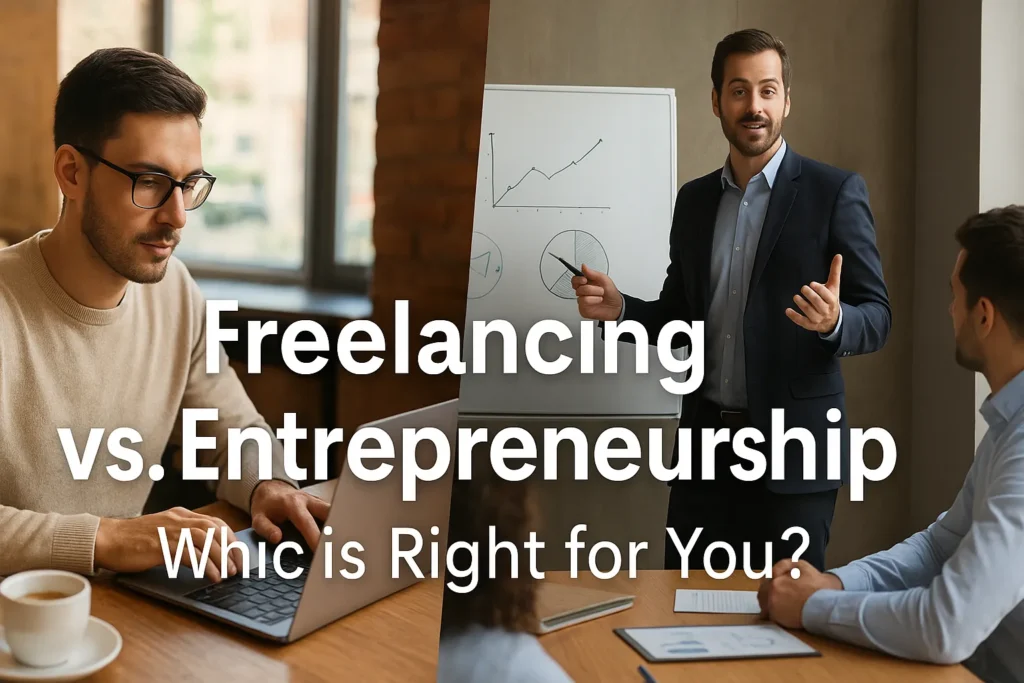
Key Differences Between Freelancing and Entrepreneurship
| Factor | Freelancing | Entrepreneurship |
|---|---|---|
| Income Source | Directly from clients | From products, services, or teams |
| Investment Needed | Low (mostly skills & laptop) | High (money, time, resources) |
| Workload | Personal work & deadlines | Managing team & business operations |
| Scalability | Limited (depends on hours worked) | High (business can grow) |
| Risk | Low to medium | High |
| Freedom | Work flexibility but income tied to hours | More freedom in long run if business succeeds |
Key Differences Between Freelancing and Entrepreneurship
Freelancing is ideal if:
- You want quick income with minimal investment.
- You prefer working solo and using your skills directly.
- You value flexibility and variety over business building.
Entrepreneurship is ideal if:
- You want to create something bigger than yourself.
- You’re comfortable with risk and delayed rewards.
- You have leadership skills and a long-term vision.
Can You Transition from Freelancing to Entrepreneurship?
Absolutely! Many entrepreneurs start as freelancers. For example:
- A freelance web designer might scale into a web development agency.
- A freelance marketer could build a digital marketing firm.
- A freelance writer could launch a content platform.
Freelancing can be the foundation for entrepreneurship — helping you gain skills, clients, and industry knowledge before scaling into a bigger business.
Conclusion
Both Freelancing and entrepreneurship have their advantages and challenges. If you want quick independence, Freelancing might be the best choice. If you aim for long-term growth, financial freedom, and creating a brand, entrepreneurship may be your path.
The key is to understand your goals, risk tolerance, and desired lifestyle. You can even start freelancing today and gradually build your way into entrepreneurship.
FAQ’s
1. Is freelancing better than entrepreneurship?
Neither is inherently better. Freelancing is best for quick income and independence, while entrepreneurship is ideal for long-term growth and scalability.
2. Can I be both a freelancer and an entrepreneur?
Yes! Many freelancers grow into entrepreneurs by turning their freelance work into a full-fledged business.
3. Which is riskier: freelancing or entrepreneurship?
Entrepreneurship carries higher financial and operational risks, while freelancing has lower risk but offers limited scalability.
4. Do I need investment to start freelancing?
No major investment is required. A laptop, internet connection, and skills are usually enough to get started.
5. How do freelancers scale into entrepreneurs?
By hiring other freelancers, creating agencies, or developing products/services that don’t rely solely on their own time.
6. Which path offers more financial freedom?
Entrepreneurship has higher financial freedom potential, but freelancing provides immediate and consistent earnings.
7. Who earns more: freelancers or entrepreneurs?
Freelancers can earn well, but entrepreneurs have unlimited earning potential if their business succeeds.
Disclaimer
This article is for educational purposes only and does not guarantee business or financial success. Always do your own research and consider professional advice before making career decisions.
Internal Link :-
- Stock Market vs. Real Estate: Which is Better in 2025?
- How to Create a Budget That You’ll Actually Stick To 2025
- AI Tools for Small Business Owners to Save Time & Money
- Best Passive Income Ideas for Beginners in 2025 – Build Wealth While You Sleep
- Credit Card Hacks to Maximize Rewards & Cashback in 2025
I don’t think the title of your article matches the content lol. Just kidding, mainly because I had some doubts after reading the article.