Explore how fake news and deepfakes are threatening democracy in 2025. Learn their impact on elections, society, and how to fight misinformation.
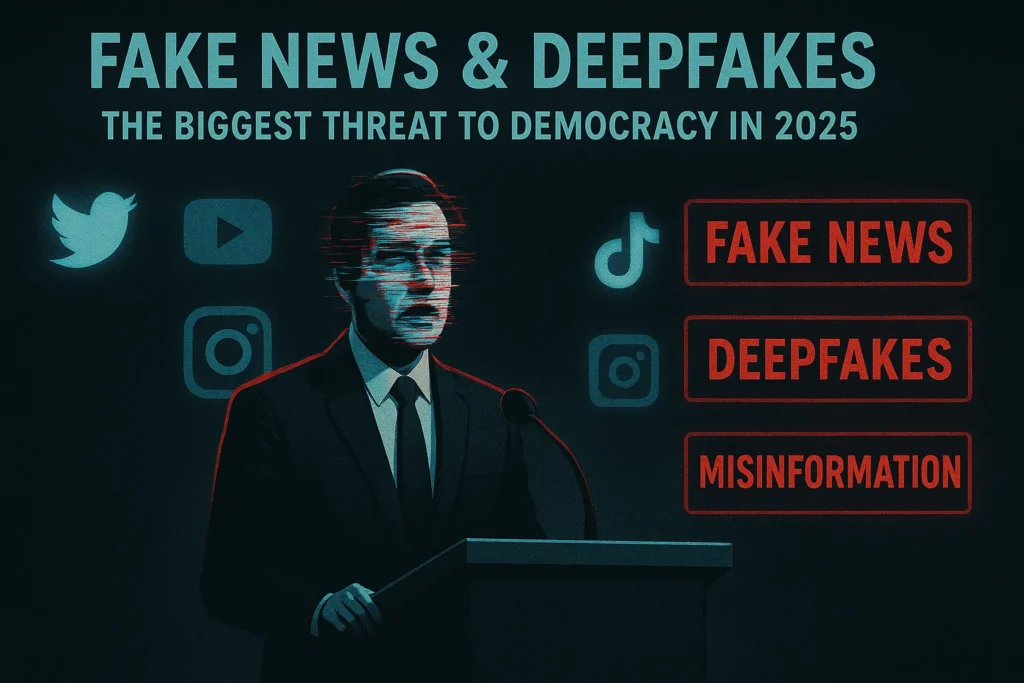
Introduction
In the digital era, information travels faster than ever. But in 2025, the rise of fake news and deepfakes has become one of the biggest threats to democracy worldwide. From misleading social media posts to AI-generated videos that look real, misinformation is shaping public opinion, influencing elections, and undermining trust in democratic institutions.
While technology has connected people globally, it has also created a dangerous weapon: the ability to manipulate truth at scale. This blog explores how fake news and deepfakes threaten democracy, their real-world consequences, and the urgent need for solutions.
Understanding Fake News and Deepfakes
What is Fake News?
Fake news refers to false or misleading information presented as legitimate news, often spread to manipulate opinions or drive political agendas.
What are Deepfakes?
Deepfakes are AI-generated synthetic media, where someone’s face, voice, or actions are digitally altered to create realistic but fake content.
Why They’re Dangerous Together
- Fake news spreads misinformation.
- Deepfakes make lies look real, amplifying manipulation.
The Role of Fake News in Modern Politics
Elections and Voter Manipulation
- In 2016, fake news stories on Facebook reached millions, influencing public perception in the U.S. elections.
- In 2019, WhatsApp misinformation campaigns in India fueled communal tensions.
- In 2024, reports showed AI-driven misinformation campaigns during European elections.
Polarization and Division
Fake news intensifies ideological divides, making societies more polarized.
Erosion of Trust
When citizens cannot distinguish fact from fiction, trust in media, leaders, and institutions collapses.
The Deepfake Danger in 2025
Political Manipulation
AI-generated videos can show leaders making false statements or engaging in scandals. Even if proven fake later, the damage to reputation is immediate.
Election Interference
Deepfake speeches or debates can mislead millions before fact-checkers intervene.
National Security Threats
Deepfakes can be used for propaganda, blackmail, or spreading panic during crises.
Example: In early 2023, a deepfake video of Ukraine’s President Zelenskyy urging troops to surrender circulated online, briefly sowing confusion.
The Economics of Misinformation
- Low Cost, High Reach: Creating fake news and deepfakes is cheap, but their viral potential is massive.
- Ad Revenue: Fake news sites often earn from clickbait advertising.
- Political Gains: False narratives are powerful tools for propaganda.
Impact on Democracy
1. Undermining Elections
When fake news dominates campaigns, voters make decisions based on lies.
2. Weakening Institutions
Deepfakes can delegitimize courts, media, and government leaders.
3. Silencing Truth
The flood of misinformation makes it harder for real news to stand out.
4. Global Consequences
Authoritarian regimes exploit deepfakes to discredit opponents, while foreign actors use them to destabilize rival democracies.
Fighting Back: Solutions Against Fake News & Deepfakes
1. Fact-Checking Initiatives
Organizations like Snopes, PolitiFact, and Alt News are fighting misinformation with real-time fact checks.
2. AI Detection Tools
Tech companies are developing algorithms to spot deepfake inconsistencies (like unnatural blinking or lip-sync errors).
3. Media Literacy Campaigns
Educating citizens to verify information before sharing is key to slowing down misinformation.
4. Stricter Regulations
Governments are introducing laws against misinformation while balancing free speech concerns.
5. Collaboration Between Tech & Governments
Partnerships are being formed to create ethical AI guidelines and stronger detection systems.
Benefits of Tackling Misinformation
- Stronger Democracies: Truth-based decisions strengthen political stability.
- Restored Trust: Media credibility and citizen trust improve.
- Safer Societies: Reduced risk of panic, violence, and polarization.
Conclusion
Fake news and deepfakes are not just technological challenges—they are existential threats to democracy in 2025. While money, power, and politics will always influence elections, misinformation has the power to distort reality itself.
The fight against misinformation requires global cooperation, advanced technology, and an informed public. If we fail to address this, democracy could be reshaped not by truth—but by the most convincing lies.
Disclaimer
This article is for educational purposes only. It does not promote or endorse any political party, leader, or ideology.
FAQ’s
1. Why are deepfakes dangerous for democracy?
Because they create realistic fake videos that can mislead voters, damage reputations, and disrupt elections.
2. How does fake news spread so fast?
Fake news spreads quickly through social media algorithms that prioritize sensational content.
3. Can deepfakes be detected?
Yes, AI-powered detection tools analyze facial movements, voice patterns, and inconsistencies to identify deepfakes.
4. How can citizens fight fake news?
By verifying information with trusted sources, avoiding blind sharing, and supporting independent journalism.
5. Which countries are most affected by misinformation?
The U.S., India, Brazil, and parts of Europe have faced major election-related misinformation campaigns.
6. Who benefits from fake news?
Political groups, foreign actors, and even fake news websites that earn money through ad clicks.
7. What’s the future of deepfakes in 2025?
They are expected to become more realistic, making detection and regulation critical to protect democracy.
Internal Link :-
- Best Home Workouts Without Equipment: Build Strength Anytime, Anywhere
- 7-Day Healthy Meal Plan for Beginners: Simple & Delicious Recipes
- 10 Best Apps to Save Money in 2025: Smart Budgeting & Financial Freedom
- How to Start Investing with Just $100 in 2025
- Best Side Hustles for Beginners to Make $500/Month in 2025
Can you be more specific about the content of your article? After reading it, I still have some doubts. Hope you can help me. https://accounts.binance.info/pl/register?ref=UM6SMJM3
Your point of view caught my eye and was very interesting. Thanks. I have a question for you.
Can you be more specific about the content of your article? After reading it, I still have some doubts. Hope you can help me.
I don’t think the title of your article matches the content lol. Just kidding, mainly because I had some doubts after reading the article.
Your article helped me a lot, is there any more related content? Thanks!
Your article helped me a lot, is there any more related content? Thanks!