Explore how BRICS and G7 are shaping the new world order. Learn about their economic power, political influence, and the global shift in leadership.
Introduction
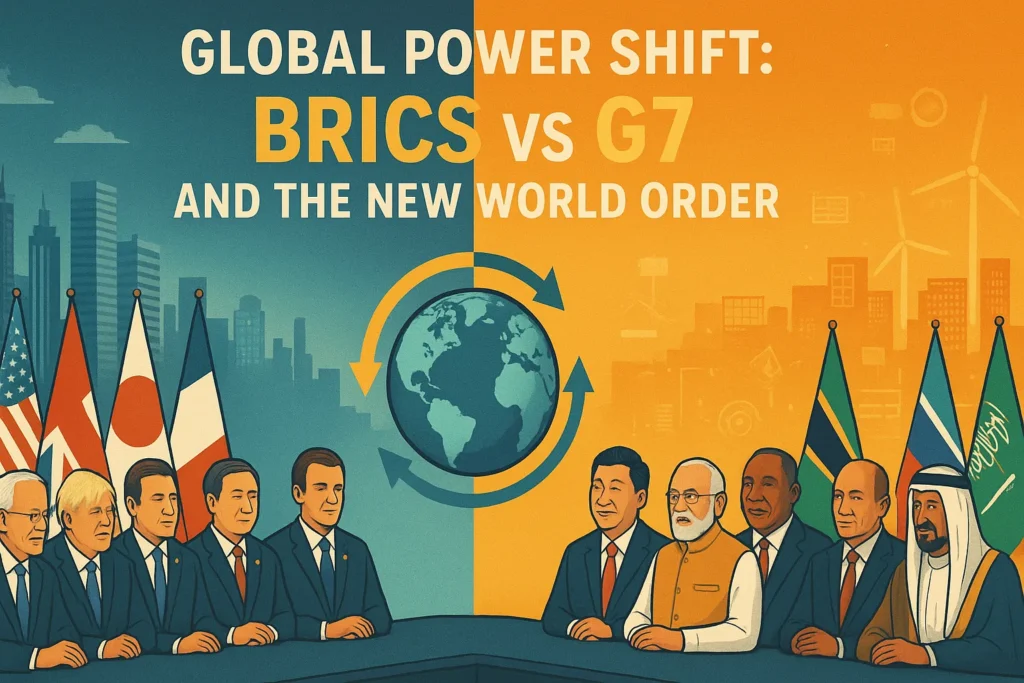
The world is witnessing a historic shift in global power. For decades, the G7 nations—a group of advanced economies—dominated international politics, trade, and finance. But in recent years, BRICS (Brazil, Russia, India, China, South Africa, and new entrants) has emerged as a powerful bloc challenging the Western-led order.
This rivalry is not just about economics; it’s about shaping the new world order, where influence, alliances, and leadership are being redefined.
Understanding G7 and BRICS
What is G7?
The Group of Seven (G7) consists of the U.S., U.K., Canada, France, Germany, Italy, and Japan. Established in the 1970s, it represents advanced industrial democracies focusing on finance, security, and global governance.
What is BRICS?
BRICS is an alliance of emerging economies—Brazil, Russia, India, China, and South Africa—formed in the 2000s. Recently, it expanded to include new members like Saudi Arabia, UAE, Egypt, Ethiopia, and Iran (in 2024), making it a stronger counterweight to the West.
Economic Power: BRICS vs G7
G7 Economic Strength
- Controls around 45% of global GDP.
- Dominates financial institutions like the IMF and World Bank.
- Sets rules for global trade and monetary policies.
BRICS Economic Strength
- Accounts for over 32% of global GDP (and rising).
- Controls significant natural resources, including oil, gas, and rare earth metals.
- Pushing for de-dollarization with local currency trade and a potential BRICS currency.
Key Difference
While G7 economies are mature but slowing, BRICS economies are younger, resource-rich, and rapidly growing, making them future growth engines.
Geopolitical Influence and Strategic Goals
G7 Priorities
- Promote democracy, human rights, and Western alliances.
- Maintain NATO’s security framework.
- Counter Russia and China’s growing influence.
BRICS Priorities
- Create a multipolar world order where no single bloc dominates.
- Increase South-South cooperation among developing nations.
- Strengthen independence from Western-controlled systems like SWIFT.
BRICS Expansion: A Turning Point
- The inclusion of oil giants (Saudi Arabia, UAE, Iran) shifts energy influence from West to East.
- Africa (Ethiopia, Egypt, South Africa) strengthens BRICS’ role in emerging markets.
- With expansion, BRICS represents 47% of the world’s population and controls key energy routes.
This expansion signals a global power shift from Western dominance to multipolar cooperation.
The New World Order: Multipolarity in Action
From Unipolar to Multipolar World
After the Cold War, the U.S. emerged as the unipolar power. But rising BRICS influence is reshaping geopolitics into a multipolar system, where power is distributed among multiple centers.
Key Drivers of the New World Order
- Energy Realignment: BRICS controls significant oil and gas reserves.
- Currency Wars: Push for trade in yuan, rupee, and a potential BRICS currency reduces reliance on the U.S. dollar.
- Technology & Trade: China and India dominate supply chains, while Russia ensures resource security.
- Global South Leadership: BRICS offers an alternative voice to developing nations often sidelined by the G7.
Benefits of BRICS vs G7 Rivalry
For Developing Countries
- More financing options (BRICS New Development Bank vs IMF/World Bank).
- Greater bargaining power in trade deals.
For Global Economy
- Healthy competition leading to innovation in trade, finance, and technology.
- Reduced monopoly of Western-led institutions.
For Citizens Worldwide
- Potential for fairer trade, more job opportunities, and stronger infrastructure investments.
Challenges Ahead
For BRICS
- Internal differences in ideology and governance.
- Balancing the power struggle between China and India.
- Building trust in a new financial system.
For G7
- Aging populations and slowing economies.
- Rising debt levels.
- Struggling to maintain influence in the Global South.
Conclusion
The BRICS vs G7 rivalry represents more than just economic competition—it is about who will define the future rules of global order. While the G7 relies on its established influence, BRICS is rising with youth, resources, and expansion.
The world is shifting from a unipolar, Western-dominated system to a multipolar era, where cooperation, competition, and balance of power will shape the new world order.
Disclaimer
This blog is for educational purposes only. It does not promote or endorse any political bloc, government, or ideology.
FAQ’s
1. What is the main difference between BRICS and G7?
G7 represents advanced industrialized nations, while BRICS consists of emerging economies with growing global influence.
2. Which countries are in BRICS+ after expansion?
As of 2024, BRICS includes Brazil, Russia, India, China, South Africa, Saudi Arabia, UAE, Iran, Egypt, and Ethiopia.
3. Why is BRICS seen as a challenge to G7?
Because BRICS pushes for de-dollarization, controls vital resources, and represents the Global South’s interests.
4. What does multipolar world order mean?
It refers to a global system where power is distributed among several blocs, not dominated by one.
5. Which group has more economic power: BRICS or G7?
Currently, G7 leads in GDP, but BRICS is rapidly catching up due to population size and resources.
6. Will BRICS launch its own currency?
Talks are ongoing, but no official BRICS currency has been launched yet.
7. How does this rivalry affect ordinary people?
It influences trade, job opportunities, energy prices, and global financial stability.
Internal Link :-
- Best Home Workouts Without Equipment: Build Strength Anytime, Anywhere
- 7-Day Healthy Meal Plan for Beginners: Simple & Delicious Recipes
- 10 Best Apps to Save Money in 2025: Smart Budgeting & Financial Freedom
- How to Start Investing with Just $100 in 2025
- Best Side Hustles for Beginners to Make $500/Month in 2025
Your article helped me a lot, is there any more related content? Thanks!